by Albert Venter | Nov 21, 2023 | Pool
Can you forget how to swim?
Can we forget how to swim? Many people have already asked themselves this question, whether after ten years or ten months. Fortunately, the quick answer is no. The lengthier answer requires some commitment and patience, but these top suggestions for coming back to swimming after a long break will help you on your way back to the pool.
STRENGTHEN YOUR CORE.
Although swimming works practically every muscle in the body, from the neck to the legs, it is primarily the core that is in charge of coordinating all of the parts. Working on core strength is essential before reintroducing the types of movements you’ll be doing when swimming. Even if your body is no longer accustomed to swimming freestyle or backstroke, a strong spine will give you the foundation you require to reintroduce your old strokes. Fortunately, there are a number of exercises you can do outside of the pool to begin strengthening your core before returning to the pool, such as volleyball or planks.
PRACTICE KEEPING YOUR HEAD ABOVE WATER.
When you’re ready to go to the pool, it’s essential to take things as slowly as you need to. Can you lose your ability to swim with your head in or out of the water? You should not expect to perform at the same level the first time you return to the pool after a long vacation, regardless of whether you were on your water polo team when you were younger or used to swim in the sea every summer. Instead, warm up outside the pool before cautiously stepping in until your feet are no longer touching the ground. Try to keep your head above water while swimming left or right. This can assist to awaken your instincts as a swimmer and make you feel more confident in the water. If you don’t feel ready to jump right in, you can start in the shallow end and work your way down.
START WITH BREASTSTROKE
Although everyone has a preferred swimming technique, breaststroke is usually a decent place to start when tackling your first lap. Breaststroke not only allows you to maintain your head above the water and gaze ahead, but it is also less exhausting and will make you feel more at ease in the water, especially if you are apprehensive. Just keep in mind that swimming with your head above the water can cause neck strain in the long run.
CHOSE A QUIET LANE
The anxieties you may feel upon returning to swimming after a lengthy layoff will usually dissipate after a few laps back and forth to familiarise yourself with your technique. It may still be beneficial to choose a more calm and less crowded lane so that you can move as slowly as you like and stop anytime you need to without blocking other swimmers.
SET REALISTIC GOALS
Even if you’re most concerned about forgetting your freestyle, swimming isn’t all about technique. It is a sport that involves a particular level of physical ability and endurance, so instead of racing from one end of the pool to the other, consider swimming one lap at a time and resting in between. Increase it to two at a time as you become more comfortable, and so on.
It could take you one session or weeks to remember your prior technique; it all depends on your previous skill of swimming. This is why it’s critical to create realistic goals that are in line with your abilities and ambitions.
by Albert Venter | Nov 20, 2023 | Pool
Regular pool maintenance is essential to keep a pool clean, safe, and enjoyable. Here’s a general guide to routine pool maintenance:
- Skimming and Cleaning Debris:
- Use a skimmer net to remove leaves, bugs, and other debris from the water’s surface.
- Empty skimmer baskets and pump baskets regularly to maintain proper water flow.
- Vacuuming:
- Vacuum the pool at least once a week to remove dirt and debris that settle on the pool floor.
- Consider an automatic pool cleaner for more frequent and efficient cleaning.
- Brushing:
- Brush the pool walls and floor to prevent algae growth and remove any built-up dirt or scale.
- Pay attention to corners, steps, and other areas that may accumulate debris.
- Water Circulation:
- Ensure proper water circulation by running the pool pump for an adequate amount of time each day.
- Check that the return jets are positioned to create a circular flow for optimal water distribution.
- Pool Filter Maintenance:
- Clean or backwash the pool filter regularly, depending on the type of filter (sand, cartridge, or diatomaceous earth).
- Replace filter media or cartridges as recommended by the manufacturer.
- Water Chemistry:
- Test the pool water regularly for pH, chlorine or bromine levels, alkalinity, and calcium hardness.
- Adjust chemical levels as needed to keep the water balanced and within the recommended ranges.
- Shock Treatment:
- Perform regular shock treatments to oxidize contaminants, eliminate chloramines, and keep the water clear.
- Follow the manufacturer’s instructions for the type and amount of shock treatment to use.
- Algae Prevention:
- Use algaecides as a preventive measure, especially during the warmer months.
- Maintain proper water circulation and chemistry to discourage algae growth.
- Tile and Coping Cleaning:
- Clean pool tiles and coping regularly to remove any built-up scale or dirt.
- Use a pool-safe cleaner and a soft brush to avoid damaging the surfaces.
- Inspect Equipment:
- Regularly inspect and maintain pool equipment such as pumps, motors, and heaters.
- Address any issues promptly to prevent further damage.
- Winterizing (Seasonal):
- If applicable, follow proper winterization procedures before closing the pool for the offseason.
- Cover the pool to prevent debris accumulation and algae growth.
Please note that the maintenance tasks required for your pool may vary depending on its size, location, and climate. To get the best advice for your pool, we recommend speaking to a PoolXpert. Regular and proactive maintenance is crucial to keep your pool clean, clear, and ready for use.
by Albert Venter | Oct 28, 2023 | Pool, Pool Cleaners
HOW TO INSTALL A SUCTION CLEANER?
How to install a suction cleaner to your pool. Installing a suction pool cleaner involves connecting the cleaner to the pool’s circulation system. Start by reading the manufacturer’s manual that comes with your suction pool cleaner. This will provide specific instructions and any unique steps for your particular model.
STANDARD INSTALLATION
Identify the skimmer or dedicated suction port in your pool where you will connect the cleaner. Most suction cleaners connect to the skimmer, but some pools have a dedicated suction port for cleaners.
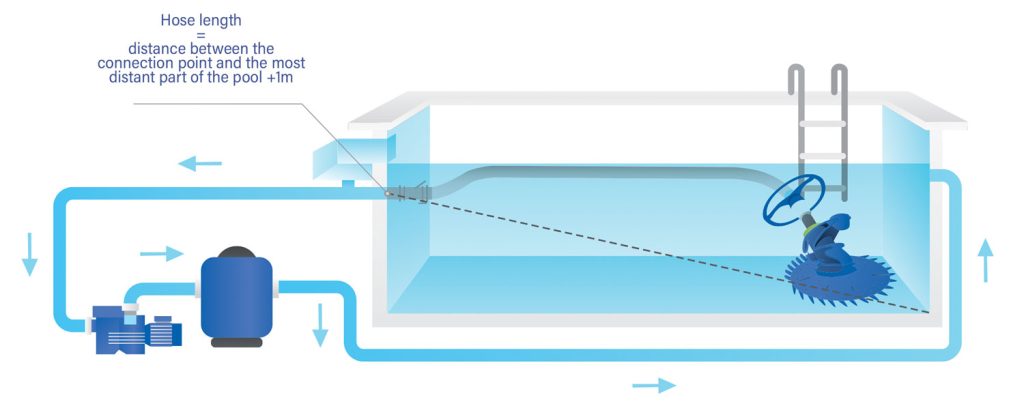
If the suction cleaner didn’t come with pre-assembled hoses, connect the hose sections according to the manufacturer’s instructions. The ideal hose length for the pool equals the greatest distance that the cleaner can cover in the pool from the connection point (skimmer) to the farthest corner of the pool, plus a 1 meter section. Connect one end of the hose to the suction cleaner. Ensure it is securely attached, and if there are any hose clamps, tighten them as specified in the manual.
Connect the other end of the hose to the skimmer or suction port. If your pool has a dedicated suction port, it might be located on the side of the pool.
Install flow regulator valve (if needed). Some suction cleaners require a flow regulator valve to control water flow. Install it in the hose according to the manufacturer’s instructions. For optimal installation, perform a flow test and adjust the flow rate using an adjusting valve.
Adjust the length of the hose to ensure the cleaner can reach all areas of the pool. If your cleaner comes with hose weights, attach them as needed to keep the hose submerged.
Turn on the pool pump to start the circulation system. This will provide the necessary suction for the cleaner to move around the pool. Watch the cleaner in action and make any necessary adjustments to the hose length, hose weights, or flow regulator valve to optimize its performance.
by Albert Venter | Apr 12, 2022 | Pool
Get your pool ready for winter
Get your pool ready for winter.. South Africans are lucky. We, mostly, have sunny skies all year round. But, on the flip side, just because the sun is up there, doesn’t mean it’s warm enough to swim! That means your pool is looking at four or five months of solitude, where nobody’s jumping in, and chances are, it’s not getting care and attention. So, unless you have a heated pool or even one indoors, you need to help your pool stay at its strongest over South Africa’s wintry days and nights. You can continue taking care of chemical levels and such like manually, but what’s the point if you aren’t going to use your pool?
The good news is your pool is unlikely to freeze over!
South Africa’s temperature, again in most places, rarely drops below freezing during winter, so it’s unlikely that your pool will have an ice-related issue. That isn’t the only factor though in keeping your pool ship shape. The water that stays in your pool over winter can become chemically unbalanced, and leave you with nasty chemical deposits or corrosive damage. Not exactly things you want to deal with, when spring, and the swimming season, comes around. And, if it is one of those once-in-a-blue-moon winters, and your pool does freeze, the water can expand and damage your pool’s liner. That’s why you need to tuck in your pool for winter. It may seem like a chore, but a little hassle now could save you time and money later. If it sounds too much like hard work, or if you’d rather the peace of mind knowing that the job has been done well, get a professional pool service company to winterise your pool. If you choose to do it yourself, do it well. Properly closing your pool means that, come spring, it’ll be ready for use, and inviting enough for a swim.
Stands to reason. What’s in the water when you close your pool for winter will still be there when you open it. Leaves and algae aren’t going to magically disappear, so get your pool as clean as you can. Scoop debris and leaves out of the water with a net, and follow up by scrubbing your pool’s walls and floors with a brush. Make sure you get rid of any algae as well, by scrubbing and using a good algaecide.
Want your pool water to look as new as the flower buds come spring? Get the chemistry right. Test the pH with a pool kit. It should be between 7.2 and 7.6. Too low? Add a pH increaser. Too high? Add a pH decreaser.
Your pool kit will also measure your pool’s alkalinity level. The level you’re after is between 80 and 125 ppm for gunite or plaster pools, and between 125 and 150 ppm for other types of pools. If the alkalinity is on the low side, add an alkalinity increaser. If it’s too high, use your pH decreaser.
Nope. Water hardness doesn’t mean ice over winter! It’s about how much calcium and magnesium is in the water, and it’s important for your pool water’s health. The optimal level is between 175 and 225 ppm. If your water is too hard, drain a little out and add fresh water. If it’s too soft, add a calcium hardness increaser.
This is a must-do. Shocking your pool means adding chlorine at high dose so the chlorine content level rise quickly, making your water clean and clear. Get some from your local pool centre if you don’t have some to hand.
You get lots of types of pool pumps, so follow the manufacturer’s instructions on how to rid the pipes of any debris so that they’re clean. When you’re done, remove the plugs from your pump, filter, heater, and chlorinator, and store them in the pump basket until spring has sprung.
- Clean and store pool fittings.
Now it’s time for your pool fittings. Remove diving boards, ladders, slides, skimmer baskets, handrails, and other accessories. Clean them thoroughly and put them in a safe place for the winter.
Don’t forget the final step! This is an important one, and you will need a full cover, either floating or attached, as well as it being in good condition. Pool covers get less effective with years of sun exposure and wear and tear. They can also get holes that will allow contaminants and UV rays into the water, which can compromise the water chemistry.
So, now you’re done! It’s time to go indoors and wrap up snug for winter. Light the fireplace. Turn on the gas heater. And stay warm, safe in the knowledge that even though your pool’s water will be chilly, to say the least, you’ve prepared it for the winter months! Now, you can look forward to your refreshing first dip in the spring!
by Albert Venter | Apr 12, 2022 | Pool
Drool and the pool! Your dogs and your swimming pool!
Drool and the pool! Your dogs and your swimming pool! It’s a hot day. The family is in the pool splashing around, with much mirth and merriment. Fido is running around the pool as well. After all, he’s part of the family, so he wants to be part of the fun. And so, without too much encouragement, he jumps in, leaping enthusiastically into the middle of your boisterous clan. Now, as welcome as he (or she) is in the pool, pet owners have two things to keep in mind. They have to know how to keep their pool clean as a result of this canine participation. And they also need to know that Fido’s safe in the water. Let’s look at the first challenge: keeping your pool clean when you have a dog swimming in it. There’s a belief that one dog in the pool is equivalent to 50 human swimmers! Now that does sound crazy, and looking at the figure, it’s probably an exaggeration. What is true though is that your dog will not only leave hair in the pool, he also comes equipped with dirt and other contaminants. Which can test your chemical levels to the max!
- Clean your filter regularly.
Dog hair build-up can be tough on your filter system, so you’ll need to regularly clean it to ensure your pool continues to run optimally. For a cartridge filter, spray it off more often. If you have a sand filter, you’ll want to run a regular backwash.
- Get your dog ready for his swim.
Okay, you may not have time (or opportunity) to prepare Fido before he dives in, but if you do, brush his coat with a de-shedding brush. Regularly shampooing your dogs will also make a difference. Both practises will keep him shedding unwanted hair in the pool. The other thing to think about with your dog enjoying your pool is his safety. No doubt, with a swimming canine, there’ll be loads of dog-sized fun for all! Remember though, dogs are man’s best friend, so help them stay safe in the water, just like you would young children.
- A quick word on chemicals
Chlorine is safe for dogs as long as it is not too much. A dog’s eyes, nose and ears are more sensitive than humans though, so don’t overdo it on the chlorine. If you are concerned about it, give Fido a rinse after swimming.
Many pool owners cover their pools to keep leaves and other debris out of the water. Pool owner can also use a solar cover to heat the water when the days aren’t so warm. Just remember, though covers are great to have, they can mean trouble for dogs. If your dog falls or jumps into a covered pool, the cover is disorienting, so he can get stuck under it, and it’s almost always impossible for him to find his way out. So, if you do use a pool cover, it’s a good idea to also invest in a pool fence. That way, everyone’s happy – and safe.
- Pool steps and ramps for dogs
Train your dog to enter and exit the pool via the steps. This protects him, as well as any swimmers from a dog-sized cannonball landing on their head as he jumps in. Most importantly though, laying down the rules for where he gets in and out, means he’ll always know how to navigate to dry land.
Yes, they do have instinctive doggy paddle in their skill set. But, and don’t laugh, many dogs benefit from a swimming lesson or two, as their innate technique is unlikely to earn them a spot on the Canine Olympic Swim Team. You can hire professional doggy swimming coaches, or you can teach him yourself. Just don’t chuck him in and force him to work it out on his own. Ease him in gently and stay with him till he gets the hang of it.
- Consider a doggie life jacket.
This life-saver is especially useful for dogs who aren’t yet confident in the water, have arthritis or are elderly, as well as dogs who tire easily. You can buy one from a good pet store.
- Never leave your dog in the pool unattended.
He may be the Michael Phelps of dog-swimmers, but you should never leave him unattended in the pool. Anything can happen. He may suddenly struggle with exhaustion and inhale water while struggling, which can lead to fluid in the lungs or worse.
- Don’t let your dog get too tired in the pool.
Dogs are like kids. They don’t recognise when they get tired in the pool, especially when they’re having fun. So, make him take a break at the first sign of physical fatigue. You’ll know when that is by watching his rump. The lower his bum is in the water, the more tired he is.
And let’s end with that age-old question. Can your dog drink pool water?
Well, yes, he’s made of tough stuff! But it also depends on how chlorinated the water is, and if it is highly chlorinated, it’s not healthy for your dog. So, err on the safe side, and keep a plentiful supply of fresh water on hand.
That’s it really. Playing in the pool with your dog is some of the best fun you can both have. But everything within reason. So, keep an eye out, both to keep your pool clean and Fido safe.
Happy swimming!
